Don't tempt fate, never eat late...
Apr. 19th, 2005 08:33 am![[personal profile]](https://www.dreamwidth.org/img/silk/identity/user.png) venta
ventaOn Friday I was plotting my route to Axminster: M3, M27, and a great long stretch of A35 seemed to be multimap's suggestion. It looked vaguely plausible. My boss counter-suggested a route of following the A303 all the way, but I decded to stick to my own plan. A junction or so into the M3, when the gantries were advertising "long delays" for the next six junctions, and the A303 was waggling its slip road invitingly, I suddenly saw the wisdom in the boss' plan and veered off.
And do you know what ? I had a lovely drive down. Normally, people define a "good" drive as one with no delays, but I actively enjoyed mine. Driving long distances by myself, and with my stereo currently hors de combat, the biggest enemy is boredom and a nice, friendly A road with stuff to look at beats a solid slab of motorway any day. I'm sure many people hate the A303, with its unnerving habit of devolving to one lane just as you least expect it. The people responsible for the big "A 303 - still the weakest link" signs certainly don't seem to be big fans.
But to me, pottering gently along at 60, it seemed an ideal means to convey myself to Devon. Friday evening's weather was proper Lake District-style changeable with fierce clouds, bouts of heavy rain, and abrupt spells of sunshine. The sky constantly changed colour around me, and summits of the road showed me whole counties spread out for me to admire. The changes of speed, lane, traffic and incline make the driving more interesting that the foot-down-and-go slog of the motorway, and the roadside is full of things to look at. A miniature thatched cottage advertising a thatcher, or a sign in a field which simply read "R.I.P WISDOM" - perhaps a farmer finally given up on DEFRA and the CAP.
Of course, the highlight of the A303 is that it passes incredibly close to Stone Henge, affording you nearly as good a view as the anorak'd souls clustering round the monument's perimiter fence. (Bizarrely, when I drove back Monday morning there was already a good swathe of tourists there - at 8am). I only saw Stone Henge for the first time last year, on the way to Glastonbury, and I have to admit to slight disappointment. It's a bit... small, really. I'm reliably informed that to walk up to it and stand under the dolmen stones is very impressive, but sadly that's probably a chance I'll never have. While, rationally, I can agree that its building was a remarkable feat, and that it's probably the UK's best-preserved example of stone circlery, it'll never quite live up to the image I had of it in my mind. I don't think I'll ever visit Stone Henge for fear of further disappointment; I'll stick to the Rollrights which, while smaller by orders of magnitude, are charming and their keepers don't mind visitors touching or chatting to the stones.
The other highlight of the A303 is getting to drive past the turning for Middle Wallop. If that's not entertainment, I don't know what is. I'm a sucker for interesting place names, and always have to fight the impluse to turn off onto sideroads with intriguing fingerposts. How terribly dull to force oneself to remain on the road to Axminster, when there are turnings offering such delights as Tuntunhill, Ash and Kingsbury Episcopi.
I was heading to Devon because Samantha and some friends of hers were staying in a castleling for the weekend, and had invited me to join them. Imagine driving up the road, just as the night was beginning to darken, and seeing

rising up before you, the windows glowing yellow with candlelight.
I'd not really heard of The Landmark Trust before, but their aim seems to be to go round rescuing interesting buildings which are derelict from want of porpoise, and renovating them. They try to convert them to holiday accommodation while not destroying the building's integrity, and at Shute they seem to have achieved this remarkably well.
OK, so a couple of centuries back the Gatehouse probably had a little less in the way of plumbing and a bit more in the way of drafts. But the conversion is sympathetic - and, by many standards, spartan. Although there are heaters, the main warmth comes from a wood-burning (and extraordinarily uncooperative) stove. The bedrooms are largely undecorated, and all the walls are plain - but it's not very often you can refer to "my turret" and get away with it. There is no television, though there is a shelf of books. However, it turns out that if you take some good company with you, even if a whole day is spent indoors with persistent rain lashing the windows, there is more than adequate entertainment. Particularly if the company can all cook remarkably well, and there is a healthy-looking stock of wine. And I learnt a new variation on an old game, for which the rules are below if you fancy trying it out.
Saturday was actually a gorgeous, sunny day which prodded us out of the house and over to Branscombe to take the air. Branscombe is coastal, and there's a fantastically rocky cliff path, looking out over stretches of

sparkling in the sun.
Even when vegetation closed over the path completely, in great, swooping arches sculpted (presumably) by sea winds, there were still

to look at. The local fauna seemed to be limited to tourists and cows.
The goal of our walk was Beer. Obviously. Beer is just along the coast from Branscombe. The whole area is riddled with beer, and they mine it from the living rock with pickaxes and straws. Disappointingly, the beer I had in Beer (which was made from otters) was actually a little tasteless, and seemed to be too far on the sour side for me. Pintwatch was, however, pacified with an extremely fine dish of cockles bought from a sea-front wet-fishmonger.
In summary I have learned several things: bits of Devon are really very pretty. The countryside as you drive through Wiltshire and Somerset to get there is lovely too, and properly hilly. Having a cast iron key weighing about half a pound to unlock your own turret gives an enormous sense of power. It is impossible for anyone to stand at some battlements and not shout down to the people below "your father was a hamster". I can still follow mathematical proofs while trying not to fall down a hill.
And that horribly saccharin-sounding phrase, that a stranger is a friend whom you haven't yet met, is, like most clichés, oft-repeated for a reason.
The rules of the game, for those interested.
The Simon and Donna Hat Game
Neither Simon nor Donna was present, but this is the game as explained by Simon's brother, who was. I'm unsure if they are to be credited with inventing it, or merely with propagation.
Two teams, A and B. Each person writes the names of six famous people, one per slip of paper, and drops them in a Hat. Our Hat was actually a biscuit tin.
A member of team A has exactly one minute to draw a name from the hat, describe the person so his team mates may guess, and draw another when they succeed. He continues to describe people so long as the team keeps guessing correctly, until the minute runs out. One 'pass' is allowed in the minute. Any failures/passes are returned to the Hat, and the successes counted and set aside. A member of team B then does the same, and so on, until all names have been removed from the Hat.
(This is quite a familiar game so far, I imagine...)
Round two follows along similar lines, using the same names, except the drawer of names may only use one word to describe the person pulled from the Hat. His team mates know (in theory) all the people it could possibly be, since all appeared in round one, so a one-word description is quite viable.
Round three is again similar, but the drawer may only mime to convey the name drawn. At this point, for full enjoyment, you need someone who has not quite grasped the rules and who will complain "but we've already had that name once".
At the end of round three, the scores are totted up, and the team with the most correct guesses wins. I'm not quite sure how I ended up having to mime Camilla Parker-Bowles (successfully) and Princess Diana (unsuccessfully) in the same evening.
And do you know what ? I had a lovely drive down. Normally, people define a "good" drive as one with no delays, but I actively enjoyed mine. Driving long distances by myself, and with my stereo currently hors de combat, the biggest enemy is boredom and a nice, friendly A road with stuff to look at beats a solid slab of motorway any day. I'm sure many people hate the A303, with its unnerving habit of devolving to one lane just as you least expect it. The people responsible for the big "A 303 - still the weakest link" signs certainly don't seem to be big fans.
But to me, pottering gently along at 60, it seemed an ideal means to convey myself to Devon. Friday evening's weather was proper Lake District-style changeable with fierce clouds, bouts of heavy rain, and abrupt spells of sunshine. The sky constantly changed colour around me, and summits of the road showed me whole counties spread out for me to admire. The changes of speed, lane, traffic and incline make the driving more interesting that the foot-down-and-go slog of the motorway, and the roadside is full of things to look at. A miniature thatched cottage advertising a thatcher, or a sign in a field which simply read "R.I.P WISDOM" - perhaps a farmer finally given up on DEFRA and the CAP.
Of course, the highlight of the A303 is that it passes incredibly close to Stone Henge, affording you nearly as good a view as the anorak'd souls clustering round the monument's perimiter fence. (Bizarrely, when I drove back Monday morning there was already a good swathe of tourists there - at 8am). I only saw Stone Henge for the first time last year, on the way to Glastonbury, and I have to admit to slight disappointment. It's a bit... small, really. I'm reliably informed that to walk up to it and stand under the dolmen stones is very impressive, but sadly that's probably a chance I'll never have. While, rationally, I can agree that its building was a remarkable feat, and that it's probably the UK's best-preserved example of stone circlery, it'll never quite live up to the image I had of it in my mind. I don't think I'll ever visit Stone Henge for fear of further disappointment; I'll stick to the Rollrights which, while smaller by orders of magnitude, are charming and their keepers don't mind visitors touching or chatting to the stones.
The other highlight of the A303 is getting to drive past the turning for Middle Wallop. If that's not entertainment, I don't know what is. I'm a sucker for interesting place names, and always have to fight the impluse to turn off onto sideroads with intriguing fingerposts. How terribly dull to force oneself to remain on the road to Axminster, when there are turnings offering such delights as Tuntunhill, Ash and Kingsbury Episcopi.
I was heading to Devon because Samantha and some friends of hers were staying in a castleling for the weekend, and had invited me to join them. Imagine driving up the road, just as the night was beginning to darken, and seeing
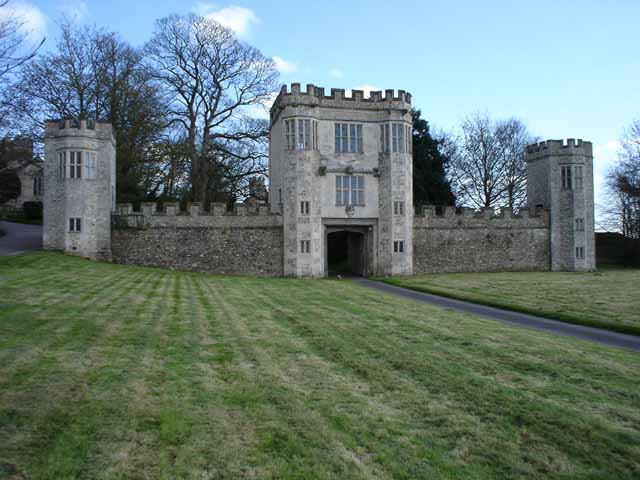
rising up before you, the windows glowing yellow with candlelight.
I'd not really heard of The Landmark Trust before, but their aim seems to be to go round rescuing interesting buildings which are derelict from want of porpoise, and renovating them. They try to convert them to holiday accommodation while not destroying the building's integrity, and at Shute they seem to have achieved this remarkably well.
OK, so a couple of centuries back the Gatehouse probably had a little less in the way of plumbing and a bit more in the way of drafts. But the conversion is sympathetic - and, by many standards, spartan. Although there are heaters, the main warmth comes from a wood-burning (and extraordinarily uncooperative) stove. The bedrooms are largely undecorated, and all the walls are plain - but it's not very often you can refer to "my turret" and get away with it. There is no television, though there is a shelf of books. However, it turns out that if you take some good company with you, even if a whole day is spent indoors with persistent rain lashing the windows, there is more than adequate entertainment. Particularly if the company can all cook remarkably well, and there is a healthy-looking stock of wine. And I learnt a new variation on an old game, for which the rules are below if you fancy trying it out.
Saturday was actually a gorgeous, sunny day which prodded us out of the house and over to Branscombe to take the air. Branscombe is coastal, and there's a fantastically rocky cliff path, looking out over stretches of
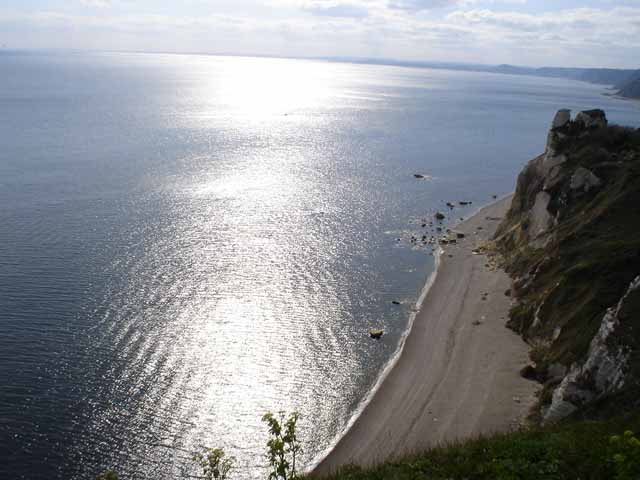
sparkling in the sun.
Even when vegetation closed over the path completely, in great, swooping arches sculpted (presumably) by sea winds, there were still
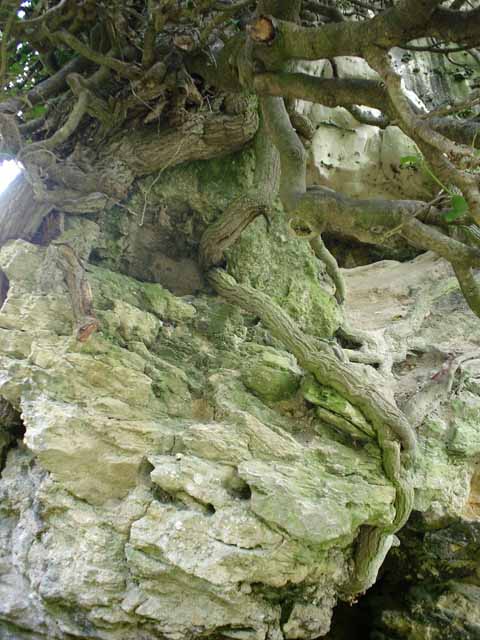
to look at. The local fauna seemed to be limited to tourists and cows.
The goal of our walk was Beer. Obviously. Beer is just along the coast from Branscombe. The whole area is riddled with beer, and they mine it from the living rock with pickaxes and straws. Disappointingly, the beer I had in Beer (which was made from otters) was actually a little tasteless, and seemed to be too far on the sour side for me. Pintwatch was, however, pacified with an extremely fine dish of cockles bought from a sea-front wet-fishmonger.
In summary I have learned several things: bits of Devon are really very pretty. The countryside as you drive through Wiltshire and Somerset to get there is lovely too, and properly hilly. Having a cast iron key weighing about half a pound to unlock your own turret gives an enormous sense of power. It is impossible for anyone to stand at some battlements and not shout down to the people below "your father was a hamster". I can still follow mathematical proofs while trying not to fall down a hill.
And that horribly saccharin-sounding phrase, that a stranger is a friend whom you haven't yet met, is, like most clichés, oft-repeated for a reason.
The rules of the game, for those interested.
The Simon and Donna Hat Game
Neither Simon nor Donna was present, but this is the game as explained by Simon's brother, who was. I'm unsure if they are to be credited with inventing it, or merely with propagation.
Two teams, A and B. Each person writes the names of six famous people, one per slip of paper, and drops them in a Hat. Our Hat was actually a biscuit tin.
A member of team A has exactly one minute to draw a name from the hat, describe the person so his team mates may guess, and draw another when they succeed. He continues to describe people so long as the team keeps guessing correctly, until the minute runs out. One 'pass' is allowed in the minute. Any failures/passes are returned to the Hat, and the successes counted and set aside. A member of team B then does the same, and so on, until all names have been removed from the Hat.
(This is quite a familiar game so far, I imagine...)
Round two follows along similar lines, using the same names, except the drawer of names may only use one word to describe the person pulled from the Hat. His team mates know (in theory) all the people it could possibly be, since all appeared in round one, so a one-word description is quite viable.
Round three is again similar, but the drawer may only mime to convey the name drawn. At this point, for full enjoyment, you need someone who has not quite grasped the rules and who will complain "but we've already had that name once".
At the end of round three, the scores are totted up, and the team with the most correct guesses wins. I'm not quite sure how I ended up having to mime Camilla Parker-Bowles (successfully) and Princess Diana (unsuccessfully) in the same evening.


![[identity profile]](https://www.dreamwidth.org/img/silk/identity/openid.png)
no subject
Date: 2005-04-19 08:39 am (UTC)It's a bit discouraging that in the very first line of the front page of his website, he misspells the word "thatcher"... I wouldn't trust him to thatch our house name onto the roof, let's put it that way.